
Not Everything You See or Hear Is True: The Significance of Verifying Information
Opay debunks September shutdown rumour
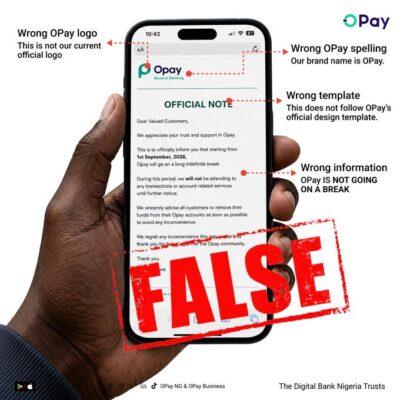
In an age where information travels faster than ever, it has become increasingly difficult to distinguish between what is true and what is simply well-packaged misinformation.
A recent viral message claiming that OPay would suspend its operations by September is a good example. The fintech company has since debunked the claim, reassuring its customers that it remains fully operational and has no plans to “go on a break.”
While the rumour may appear harmless to some, it highlights a much bigger issue; how quickly we believe, consume and circulate information without taking the time to verify it.
We live in a world where a screenshot, forwarded message or social media post can reach thousands of people within minutes. Unfortunately, the speed at which information spreads does not determine its accuracy. Something being widely circulated does not automatically make it true.
This is why we must learn to take what we see and hear with a pinch of salt!
Taking information with a pinch of salt does not mean becoming unnecessarily skeptical or refusing to believe anything. Rather, it means pausing long enough to ask important questions like; where did this information come from? is the source credible? has the organization or person involved confirmed it? is there evidence to support the claim?
In the case of the OPay rumour, a simple visit to the company's official communication channels could help separate fact from fiction. This is an important habit we should all develop, particularly when dealing with information that could influence our financial decisions, careers, relationships, health or reputation.
SO, WHAT CAN YOU AND I DO?
Pause Before You Share:
One of the biggest contributors to misinformation is not necessarily the person who creates it, but the people who unknowingly help spread it. A message may begin with one person, but every “forward,” repost, retweet or share gives it a new audience and sometimes, an undeserved sense of credibility.
There is no prize for being the first person to share information. In fact, there is far more value in being the person who shares accurate information.
Go to the Source:
When information concerns a company, institution, public figure or organization, the most reliable place to start is usually its official communication channels. Do not rely solely on what someone says they heard from someone else. Do not assume that because a message contains a logo, impressive graphics or authoritative language, it must be legitimate.
Appearance is not authenticity. Virality is not verification.
The responsibility to verify information ultimately lies with each of us.
Think Before You Believe
The OPay rumour may have been dismissed, but the lesson goes beyond one company or one viral message.
Every day, we encounter claims about businesses shutting down, policies changing, celebrities doing certain things, job opportunities, investment schemes and countless other issues. Some are genuine. Others are exaggerated, misleading or completely false.
Our response should not always be to immediately believe or immediately dismiss. Sometimes, the wisest response is simply to pause and verify.
In a world where information is abundant, discernment has become just as important as access to information.
So, the next time you receive a shocking message, hear an alarming claim or come across a viral post, remember:
Pause. Question. Verify. Then decide whether it is worth sharing.
Because not everything we see or hear deserves to be believed and certainly not everything deserves to be shared.
Read our editorial standards and corrections policy.