
Your Mother’s Voice, Without Your Mother
You know your mother’s voice. You can recognize it before she even says who is calling. Now imagine getting a call from that same voice, asking you to send money urgently. Her tone, her rhythm, even the way she pronounces your name all sound right. There’s just one problem: your mother never made that call.
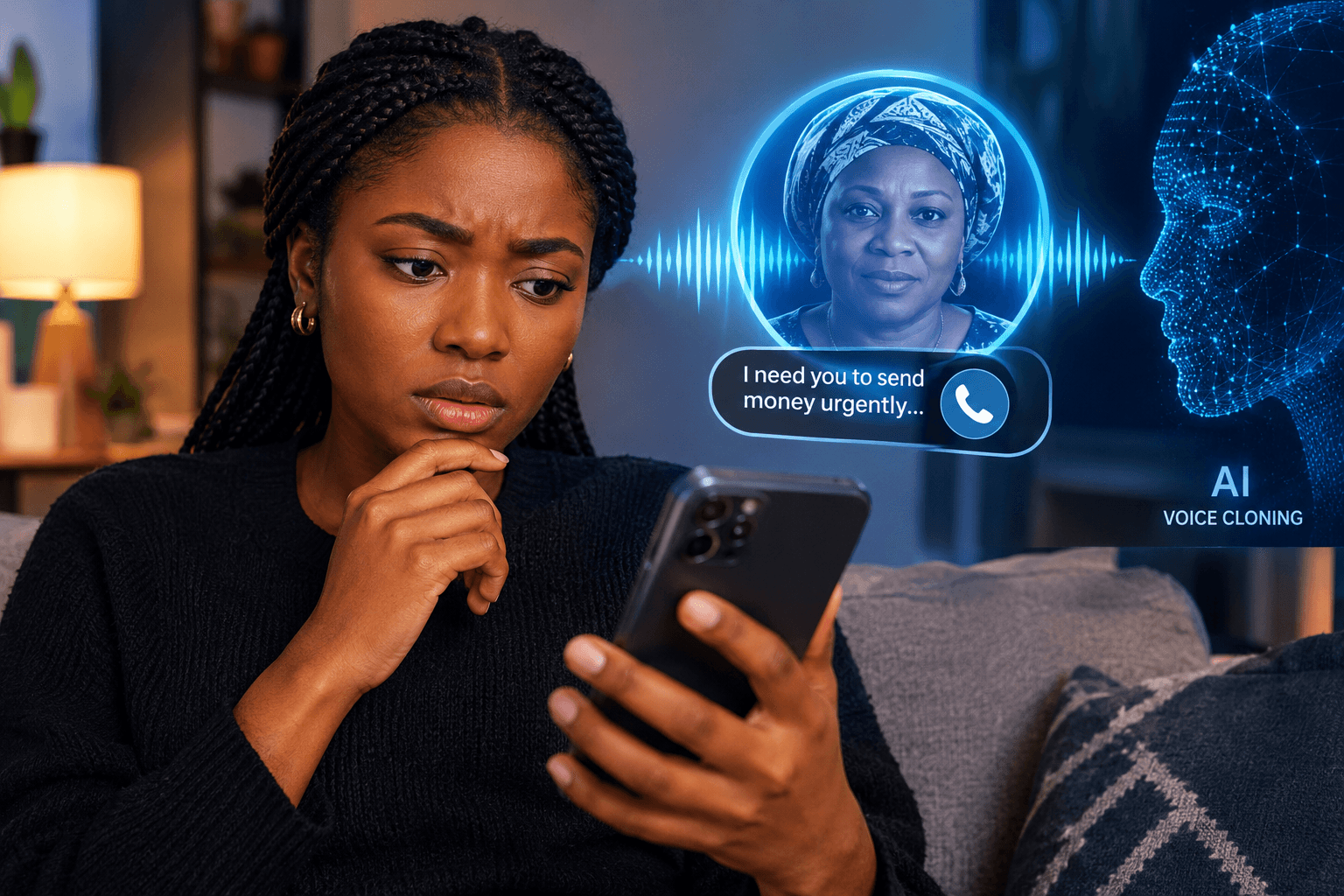
You know your mother’s voice. You can recognize it before she even says who is calling. Now imagine getting a call from that same voice, asking you to send money urgently. Her tone, her rhythm, even the way she pronounces your name all sound right. There’s just one problem: your mother never made that call.
This is now possible because of AI voice cloning, technology that can generate artificial speech resembling a real person’s voice.
For years, people have worried about fake pictures and doctored viral videos. Now even the voices we know best can’t be taken at face value. Worse, a convincing imitation no longer requires hours of recorded speech.
A Few Seconds of Audio Can Go a Long Way
Think about how often people share their voices online: TikTok videos, podcasts, Instagram stories, voice notes sent to friends. Most of us never think about what happens to those recordings once they’re posted.
How the technology works. Modern voice cloning systems are trained on huge amounts of speech from many speakers, which teaches them how human speech works in general. When given a short sample of a new voice, they extract that speaker’s characteristics, such as pitch, tone, accent, and rhythm, and use them to generate new speech from any written text. Because the heavy learning has already happened, the system needs only a small sample of the target voice. In 2023, Microsoft researchers demonstrated a model called VALL-E that could imitate a speaker from a sample of about three seconds. Quality varies by system, but the barrier to entry has dropped sharply.
The person being copied never has to say the new words. Someone could produce a recording of you saying something you never said. That is what makes the technology both fascinating and alarming.
When a Phone Call Becomes Hard to Believe
Imagine you’re at work when your phone rings. The caller sounds exactly like your younger brother, and he says he needs money urgently. You probably wouldn’t think to question him, because you recognize his voice. That trust is exactly what criminals try to exploit.
This isn’t hypothetical. In 2019, fraudsters reportedly used AI-generated audio to impersonate the chief executive of a German parent company and persuaded the head of its UK energy subsidiary to transfer roughly €220,000. In January 2024, voters in New Hampshire received robocalls with a cloned voice of President Joe Biden telling them to skip the state’s primary election.
Ordinary consumers have been warned too. In March 2023, the US Federal Trade Commission cautioned that scammers were using voice cloning to impersonate family members in fake emergencies, and that a short audio clip taken from content posted online could be enough. What sets this apart from an ordinary scam call is that the victim believes they know who is on the line.
Fear makes it worse. When a caller sounds frightened or claims to be in trouble, people feel pushed to act before they think. The danger isn’t only that AI can copy a voice. It’s that a familiar voice makes a false story easier to believe.
But There’s Another Side to the Story
It would be easy to see only the risks, but the technology also has uses that make a real difference in people’s lives. Consider someone gradually losing the ability to speak because of a medical condition. Communicating through a synthetic voice that sounds like their own could be deeply meaningful.
Apple, for example, introduced Personal Voice in 2023, which lets eligible users create a voice resembling their own for use with supported accessibility features. Voice technology is also being used in filmmaking, audiobooks, and content creation. A creator can produce narration without recording every sentence, and some tools can help adapt spoken content into other languages.
These benefits raise a question about permission. Just because technology can recreate someone’s voice doesn’t mean anyone should be allowed to use it.
Your Voice Is Personal, but Who Gets to Use It?
A face appears in photographs and a name can be written anywhere, but a voice is different. It’s one of the things that makes a person instantly recognizable, and AI voice cloning makes questions of ownership and consent harder to ignore.
Should a company be allowed to recreate an actor’s voice without their agreement? What happens when someone’s voice appears in an advertisement they never approved? Who is responsible when an artificial voice is used to deceive people?
Lawmakers and regulators have started to respond. In February 2024, the US Federal Communications Commission ruled that AI-generated voices in robocalls count as “artificial” under existing robocall law, which makes unsolicited calls using them illegal without prior consent. Also in 2024, Tennessee passed the ELVIS Act, which extends protections for a person’s name, image, and likeness to cover their voice. Some AI companies now require consent before certain voices can be cloned, but protections still vary widely from one platform to another.
Fighting Back: Detection and Defenses
The response isn’t only legal. Researchers and companies are building tools that try to detect synthetic speech, and some developers embed inaudible watermarks in generated audio so it can be identified later. Both approaches are imperfect. Detection tools can be fooled as generation improves, and watermarks only work when the generating tool adds them.
Banks and other institutions that once treated “my voice is my password” as strong security are also rethinking it, since a voiceprint can no longer be assumed to prove identity.
The Next Time Your Phone Rings
So how can you tell whether the person on the phone is real? Often, you can’t. Some artificial voices still have noticeable flaws, but others sound convincing, especially in a short conversation. That’s why security experts recommend verifying unusual requests instead of relying on a voice alone.
Here are some practical steps:
Hang up and call back on a number you already have saved, not the one that just called you.
Agree on a family code word that only your closest people know, and ask for it if a call ever feels off.
Be suspicious of pressure. Insistence on sending money immediately, or on telling no one else, are classic warning signs.
Think about what you post. You don’t have to disappear from social media, but consider who can see your videos and voice notes.
If you’ve already sent money, contact your bank or payment provider right away, then report the incident to the police or the relevant consumer protection authority.
When Hearing Is No Longer Enough
There was a time when hearing someone’s voice was enough to reassure you. AI voice cloning is beginning to challenge that assumption. The technology has opened up valuable possibilities, especially for communication and creative work, but it has also handed criminals a new way to make deception more convincing.
The challenge now is to enjoy what the technology offers without letting it become another tool for fraud. The next time a familiar voice calls with an unusual request, recognizing it may be only the beginning of knowing who is really speaking.
Read our editorial standards and corrections policy.