
How AI Can Help African Farmers Reduce Crop Losses
How can AI reduce crop losses for African farmers? Learn how AI detects disease, forecasts weather and saves harvests, which free tools exist, and what challenges remain.
Every season, African farmers risk losing the harvest they have worked months to grow. Pests, crop diseases, unpredictable weather, and poor storage and transport can destroy a crop in the field or spoil it on the way to market. For a smallholder family, that means lost income, unpaid school fees and less food at home. When losses are widespread, they also push food prices up for everyone.
Artificial intelligence (AI) is now being used to tackle these problems. It can identify a plant disease from a phone photo, warn farmers about incoming rain, and tell them when a field needs water. But there is an honest question behind the excitement: can AI really help farmers who have limited internet, little money and few digital skills? This guide answers that, along with the questions people ask most.
Quick answers
What is AI in agriculture? Software that learns patterns from data, such as photos, satellite images, weather records and soil readings, and turns them into advice a farmer can use.
Can AI reduce crop losses? Yes. It helps most by catching problems early, improving weather and planting decisions, saving water, and guiding harvest and storage.
Do farmers need expensive equipment? Not always. Some of the best tools are free smartphone apps, and some work offline.
What is the biggest barrier? Access: cost, connectivity, training and local-language support.
Why African farmers lose crops
Losses happen at every stage, from planting to the market stall.
Pests and diseases. These cut yields and lower the market value of crops and livestock. Pests can develop resistance to pesticides, new chemicals cost more, and many farmers cannot keep up. Warmer conditions can also help some insect pests spread.
Unpredictable weather. Most African farming depends on rainfall rather than irrigation, so a late season, a dry spell or a flood can decide the whole harvest. Many farmers say traditional seasonal signs no longer predict the weather as reliably. Climate change is expected to bring more extremes, so a good season may be followed by a poor one.
Post-harvest losses. A large share of food is lost after it is grown, through rough handling, poor storage, slow transport and weak market access. An FAO and World Bank report estimated the value of post-harvest grain losses in sub-Saharan Africa at around US$4 billion a year, with physical grain losses before processing commonly estimated at 10 to 20 percent. Fresh produce like tomatoes spoils even faster, though estimates vary between studies. Heat, overloaded baskets and long journeys without cooling are common causes.
The takeaway: protecting a harvest means protecting it in the field, in storage and on the road.
How AI helps reduce crop losses
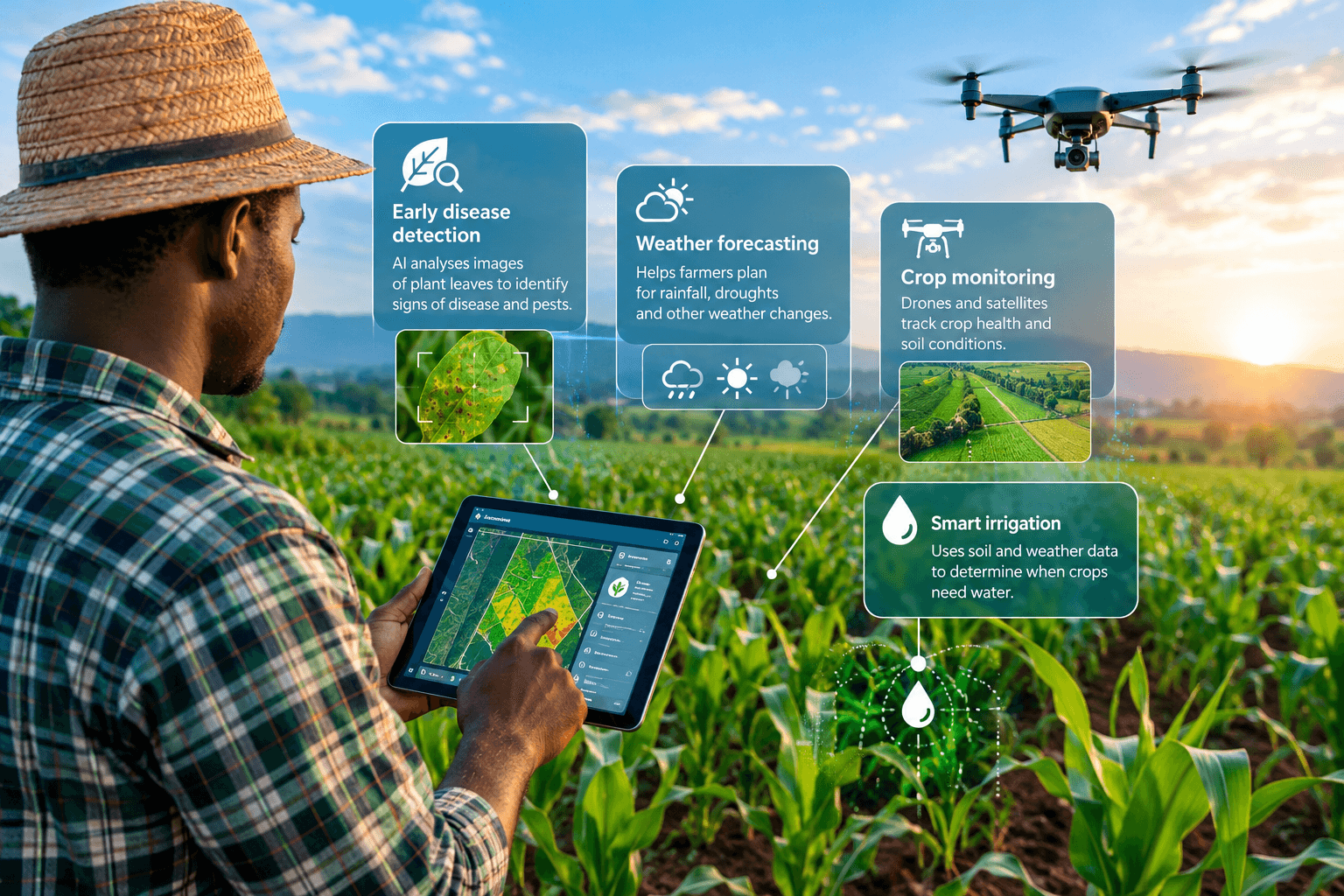
1. Early detection of diseases and pests. Some apps analyse a photo of a leaf and suggest what the problem is and how to respond. Catching an outbreak early can save a large part of a harvest. Real examples include:
PlantVillage Nuru, built for smallholder farmers, which diagnoses cassava diseases and fall armyworm damage in maize. It works offline and is free to download.
Plantix, which gives diagnoses and treatment advice from photos and can also be used offline, uploading data later when a connection returns.
Aerobotics, a South African company that uses AI to assess the condition of fruit trees so growers can find and manage problem areas.
2. Weather forecasting and early warning. AI-supported tools can give more localised information on rainfall, floods and dry spells, helping farmers decide when to plant, apply fertiliser or harvest before heavy rain.
3. Crop monitoring. AI can read satellite and drone images to show which parts of a field are stressed or where disease may be starting. This suits large farms, cooperatives and extension services that watch many plots at once.
4. Smart irrigation. By combining soil moisture data with weather information, AI can estimate when crops actually need water, reducing waste and protecting yields.
5. Harvest timing and market planning. AI can help estimate the best time to harvest, and better data on demand and prices can help farmers avoid sending produce to markets that cannot absorb it, a major cause of spoilage in bumper seasons.
6. Machinery, advice and finance. Hello Tractor, a Nigeria-based platform, connects smallholders with tractor owners and uses AI to help owners track what their machines do in the field. Other tools use farm data to help farmers access credit and insurance.
Frequently asked questions
Can AI help farmers without smartphones or internet?
Less directly, but yes. Some tools work offline, and cooperatives and extension officers can share one device and pass advice to many farmers. In a programme in Kenya, trained lead farmers each helped about twenty neighbours learn to use an AI diagnosis app. Voice and text-message services can also carry AI-generated advice to basic phones.
Is AI farming technology expensive?
It depends. Drones, sensors and smart irrigation can be costly for smallholders, but many phone-based diagnosis and advisory tools are free or cheap. Start with free tools and share equipment through cooperatives or service providers.
How accurate is AI at diagnosing crop diseases?
Useful, but not perfect. An app is only as good as the data it learned from, so it may work well for some crops and regions and poorly for others. Treat results as guidance and confirm serious cases with an extension officer.
Will AI replace farmers or extension officers?
No. It works best by supporting them, giving farmers faster information and helping extension workers reach more people.
Does AI help livestock farmers?
Yes, but livestock has received less attention than crops, so more investment is needed.
How can a farmer start today?
Try a free plant-diagnosis app that covers your crop and region.
Join a farmers’ group or cooperative for shared tools and training.
Use weather and advisory services to plan planting, spraying and harvest.
Pair technology with proven basics: clean storage, airtight bags or silos for grain, careful handling and shade for produce.
Keep records of yields and problems, because good data makes every future tool more useful.
Challenges of using AI in African agriculture
Digital literacy and trust. Without training, tools may be misused or distrusted.
Poor connectivity. Many rural areas have weak or no internet. Offline tools help but do not solve this.
Cost. Equipment, data and phone costs can be too high for farmers on small margins.
Maintenance and support. Devices need repairs and updates, which may be far away.
Data gaps. Models trained elsewhere may not fit African crops, pests and languages, and farmers’ data must be protected.
Unequal benefits. Many innovations target large commercial farms, leaving smallholders, women and young people behind.
What needs to happen next
For AI to work for everyone, the priorities are affordable tools, practical training through trusted local champions, better rural connectivity, electricity and cold storage, local data and languages, fair data protection rules, and partnerships between governments, researchers, technology companies and farmer groups.
Conclusion
Can AI reduce crop losses in Africa? Yes, with conditions. It can help farmers detect diseases earlier, prepare for weather, use water wisely and time their harvest better. It works best alongside good farming practices, reliable storage and transport, and strong support for farmers. What will decide its impact is whether the smallholder farmer who grows much of the continent’s food can actually use it. With affordability, training and connectivity in place, these tools can move from pilot projects to everyday help, reducing losses, protecting incomes and strengthening food security for years to come.