
2026 Nobel Prize Winners: Complete List and Their Work
Meet the 2026 Nobel Prize winners in Medicine, Physics, Chemistry, Literature and Peace, and discover the discoveries and work behind each award
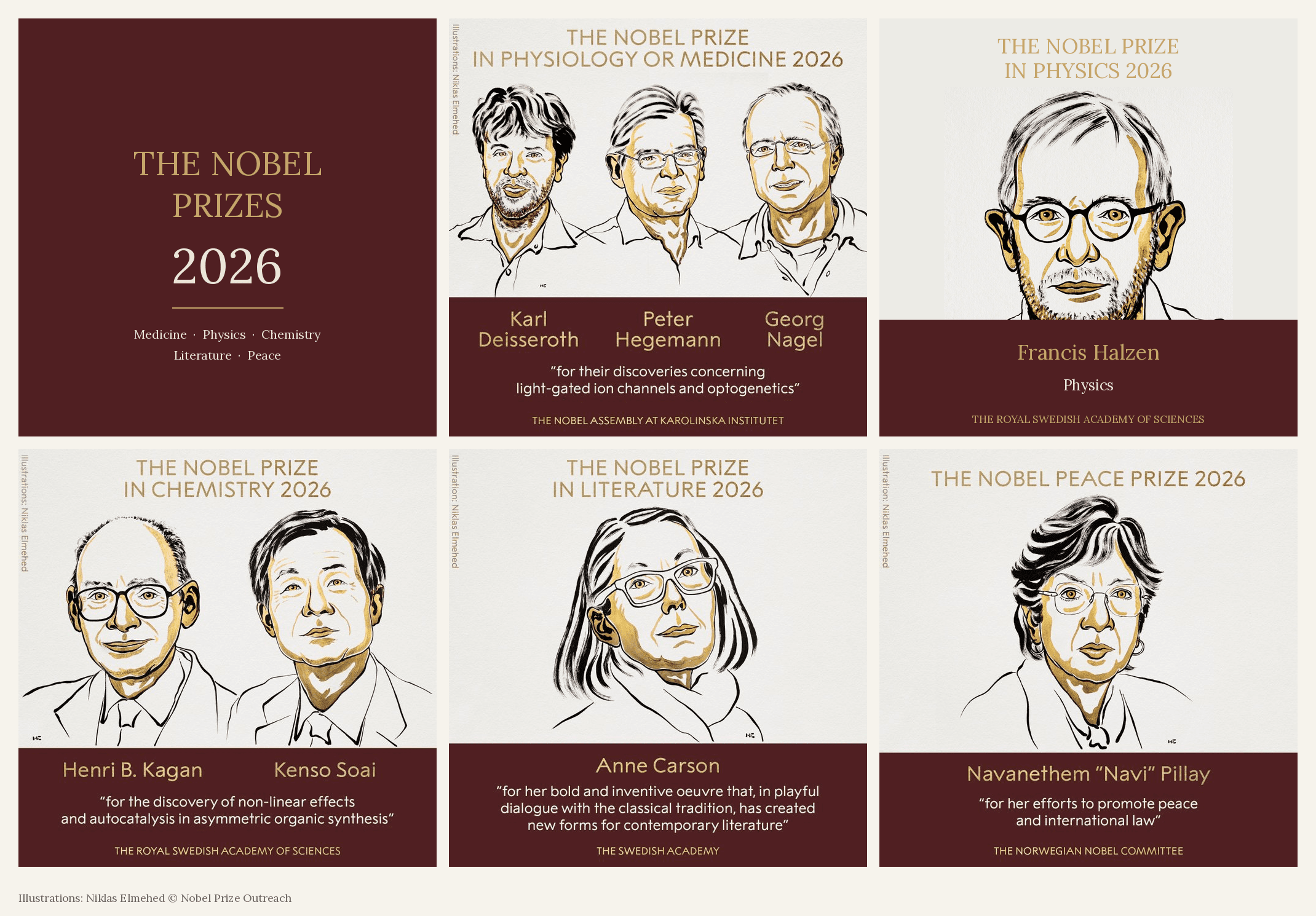
The 2026 Nobel Prize winners have been announced, and each one heard the news in a call from Stockholm. For five days, ordinary mornings were interrupted by the call that turns decades of work into a Nobel Prize. Karl Deisseroth, the 2026 laureate in Physiology or Medicine, was finishing a paper late on Sunday night when his call came. The news interrupted his sleep and disrupted his life, though in the best way. He said he would use the quiet hours before dawn to take a breath and think about the future. Below is the complete list of winners by category, and what each of them achieved.
Georg Nagel who shared the prize with Deisseroth was in Italy on a sun-drenched terrace, overlooking olive and lemon trees on Monday morning when he got the call. He describes his surprise at the news and opines that he thinks it is too early to get a Nobel laureate from the field he was working on.
Francis Halzen was attending a science fair in Belgium and was working on a proposal when the Nobel Institute’s call came. “Our prime minister wants to call me” announced Kenso, the Chemistry laureate in as he interrupted the call with Adam Smith, the Institute’s representative on October 7, 2026.
Anne Carson stood bewildered in her kitchen in Reykjavík, Iceland as she received the call informing her that she was the 2026 Nobel Prize laureate in literature. She was just eating crackers and drinking a cup of tea. What next, the representative of the Nobel Institute asked over the call? “I will take a walk in the wood and hear the quiet” said Carson.
Navi Pillay, the Peace laureate had to call Kristian Berg Harpviken, the Director of the Norwegian Nobel Institute to confirm her prize. She could not believe the announcement except she heard it from the horse’s mouth.
The 2026 Nobel Prizes are more than a celebration of individual brilliance. Taken together, they reveal what contemporary science, literature and society are trying to understand how life can be manipulated with light, how the universe can be observed through particles that barely interact with matter, how chemistry can control the molecular handedness on which medicines and perhaps life itself depend.
KARL DEISSEROTH, PETER HEGEMANN AND GEORG NAGEL
Karl Deisseroth, Peter Hegemann and Georg Nagel were awarded the 2026 Nobel Prize in Physiology or Medicine for their discoveries neuroscience specifically, light-gated ion channels and optogenetics. Their decades of study has revolved around answering the question; how does an alga orient itself toward light? Optogenetics is a biological technique making it possible to switch the activity of individual nerve cells in a living brain on or off. This facilitates deeper investigation into the roles of nerve cells and neural circuits which influence how the brain forms memories, feelings and behaviours. Simply put, optogenetics is foundational to our understanding of the brain.
Hegemann and Nagel discovered channelrhodopsin, a unique algal protein on the cell’s surface which opens up a channel when exposed to blue light. This channel allows charged ions to flow into the cell, creating an electrical impulse. Deisseroth transformed channelrhodopsin into a light-controlled switch for nerve cells through experiments that were successful on mice.
Karl Deisseroth was born in 1971. He received his PhD from Stanford University, USA and is presently a D.H. Chen Professor, Professor of Bioengineering and of Psychiatry and Behavioral Sciences, at the Howard Hughes Medical Institute and Stanford University, USA. Peter Hegemann born in 1954 received his Ph.D. from the Max-Planck-Institute for Biochemistry, Martinsried, Germany. He is currently Hertie Senior Professor of Neuroscience at the Humboldt University of Berlin, Germany. Georg Nagel born in 1953 received his Ph.D. from the University of Frankfurt, Germany. He is currently professor of molecular plant physiology at the Department for Molecular Plant Physiology and Biophysics- Botany I, University of Würzburg, Germany.
FRANCIS HALZEN
Francis Halzen is the 2026 Physics laureate for his decisive contributions to the IceCube Neutrino Observatory and the discovery of high-energy neutrinos of astrophysical origin. It was Halzen’s idea that ice in the South Pole could be used to detect and trap neutrino’s. He conceived the IceCube observatory which was completed in 2011 and covers a cubic kilometre of ice.
The observatory equipped with light sensors can capture neutrinos from extremely energy-rich processes in the distant universe. When a neutrino collides with an atomic nucleus, it produces a flash of light that can be tracked by sensors in the clear glacial ice. Unlike other cosmological particles, neutrinos do not change direction or reduce their speed when they reach earth. These neutrino interactions are collected by IceCube researchers and they reveal the source of such particles and the universe’s black holes.
The Physics laureate was born in 1944 in Tienen, Belgium. He received his PhD in 1969 from KU Leuven, Belgium. He is currently a professor at the University of Wisconsin-Madison, USA
HENRI KAGAN AND KENSO SOAI
Henri B. Kagan and Kenso Soai were jointly awarded the Nobel Prize in Chemistry on Wednesday 7th October, 2026 contribution to presenting a solution to Life’s chemistry- homochirality. Chirality, a state when molecules appear in two forms that mirror each other, is the focus of this year’s Chemistry prize. Their discoveries have enabled chemists to induce chemical reactions that result to homochirality- when a group of molecules consists of only right enantiomers or left enantiomers.
Kagan’s study of non-linear effects discovered a novel way of manipulating chemical reactions that allows the creation of an excess of mirror images previously not thought possible. Soai went further to design the first chemical reaction- the eponymous Soai reaction, where only one of the potential mirror images was formed, acts as its own catalyst. The achievement of this molecular asymmetry can be impactful in the manufacture of pharmaceuticals, flavours, scents and new materials. This would be the 26th time the Chemistry prize has been shared between two laureates.
Born in Boulogne-Billancourt, France, Kagan is the second-oldest chemistry laureate at 95 years old after John Goodenough who received the prize at 97 in 2019. He earned his PhD in 1960 form College de France, France. He is professor emeritus at Universite Paris-Saclay.
Kenso Soai born in 1950 in Hiroshima, Japan, earned his PhD in 1979 from the University of Tokyo. He is an emeritus professor at the Tokyo University of Science.
ANNE CARSON
Canadian-born Anne Carson was awarded the Nobel Prize in Literature “for her bold and inventive oeuvre that, in playful dialogue with the classical tradition, has created new forms for contemporary literature.” The 123rd Literature laureate, Anne Carson is a Professor of Classics. Her oeuvre covers poetry, prose and essays with her eccentric fusion of forms, themes, myths and texts from classical Greek literature. The 76 year-old has explored the possibility of writing and has greatly expanded the horizon for the experimentation of literary form.
Autobiography of Red: A Novel in Verse (1998), The Beauty of the Husband: A Fictional Essay in 29 Tangos (2001), Nox (2010), Float (2016) and Wrong Norma (2024) are some of her works. She has combined her writing and translation with teaching in various universities.
NAVANETHEM “NAVI” PILLAY
Navanethem “Navi” Pillay was awarded the Peace Prize for her efforts to promote peace, justice, human rights and international law as an individual and from the bench. From representing Nelson Mandela in apartheid South Africa, the International Criminal Tribunal for Rwanda (ICTR), judge of the International Criminal Court and the United Nations High Commissioner for Human Rights, Ms. Pillay’s voice resonates.
The Peace laureate led the U.N. commission of Inquiry on the Occupied Palestinian Territory that concluded in 2025 that Israel committed genocide in Gaza. She agrees that the prize pays tribute to her courage in categorizing the events in Gaza a genocide. “Why would you need courage to speak the truth” she asked. The renowned jurist went on to dedicate the prize to victims of international crime as well as other defenders of international justice.
Born in Durban, South Africa to a family of Indian descent in 1941, she became one of the first women of colour to run her own law firm in apartheid South Africa. In 1992 she co-founded a women’s right organization, Equality Now with Jessica Neuwirth and Feryal Gharani.