Major Types of Cyber Threats, How They Work and How to Defend Against Them
Cyber Threats: Types, Classification and Real-World Incidents
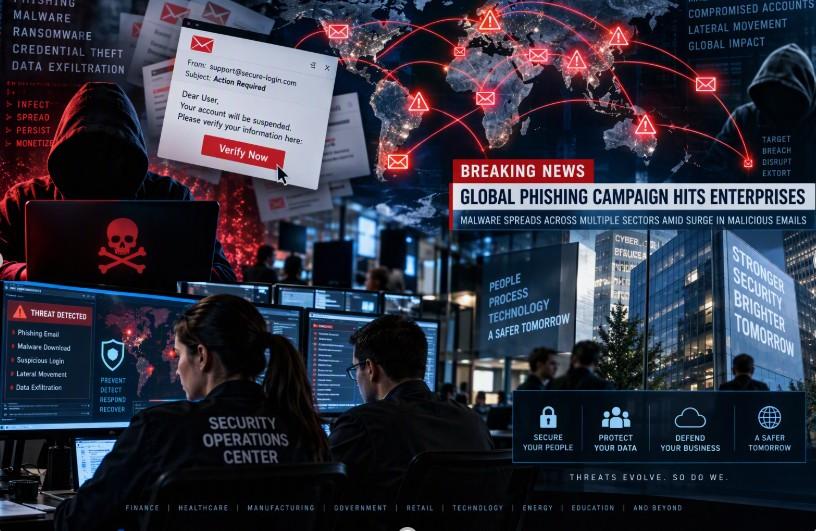
Cyberattacks do not always begin with sophisticated hacking. Sometimes, they start with an email that looks legitimate, a reused password or a phone call from someone pretending to be a company executive.
The consequences can be far-reaching. Criminals can steal money and personal information, businesses can lose access to essential systems, and attacks on critical infrastructure can disrupt services that millions of people depend on.
Cyber threats take many forms, and understanding their differences is an important step towards defending against them. Some exploit weaknesses in software, while others manipulate people into handing over access. Others target the suppliers, connected devices and digital infrastructure that organisations rely on.
Here are some major types of cyber threats, how they work and what real-world incidents reveal about their potential impact.
MALWARE:When Software Becomes a Weapon
Malware is any software intentionally designed to damage, disrupt, spy on or gain unauthorized access to systems. It remains one of the most common forms of cyberattack.
Viruses attach themselves to legitimate programs and spread when infected files are executed. Worms are self-replicating malware capable of spreading across networks without user action. Trojans disguise themselves as legitimate software to trick users into installing them. Spyware secretly collects information about users and their activities, while adware aggressively displays unwanted advertisements and sometimes gathers browsing information.
Ransomware is among the most destructive malware categories. It encrypts files and systems before demanding payment for decryption. The WannaCry outbreak affected organizations across more than one hundred countries, while the Colonial Pipeline attack demonstrated how ransomware can disrupt critical infrastructure. NotPetya caused billions of dollars in damages worldwide and remains one of the most expensive cyber incidents in history.
Rootkits are specialized malware designed to hide malicious activities from security tools. Botnets consist of compromised devices remotely controlled by attackers. Criminal groups use botnets to launch spam campaigns, distribute malware and conduct denial-of-service attacks.
PHISHING AND SOCIAL ENGINEERING
Phishing attacks manipulate human behavior rather than exploiting software vulnerabilities. Attackers craft convincing emails, text messages, phone calls or social media messages that impersonate trusted organizations.
Email phishing remains the most widespread form. Spear-phishing targets specific individuals with personalized messages. Whaling attacks focus on executives and senior leaders. Smishing uses text messages, while vishing relies on voice calls. Clone phishing replicates legitimate communication and replaces links with malicious versions.
The success of social engineering demonstrates that humans are frequently the weakest link in cybersecurity. A single employee who reveals credentials can provide attackers with access to an entire corporate environment.
BUSINESS EMAIL COMPROMISE
Business Email Compromise, commonly called BEC, is a specialized form of social engineering. Criminals impersonate company executives, suppliers or business partners to trick employees into transferring funds or revealing confidential information.
Organizations worldwide have lost billions through BEC attacks. Unlike ransomware, BEC requires little malicious code. Instead, attackers exploit trust, urgency and poor verification practices.
PASSWORD AND CREDENTIAL ATTACKS
Credentials remain valuable targets because they provide direct access to systems and data. Cybercriminals use brute-force attacks, dictionary attacks, password spraying and credential stuffing.
Credential stuffing uses usernames and passwords leaked from previous breaches. Since many users reuse passwords across multiple services, attackers often gain access to additional accounts. Keyloggers, phishing campaigns and information-stealing malware also support credential theft operations.
MULTI-FACTOR AUTHENTICATION BYPASS ATTACKS
As organizations adopt multi-factor authentication, attackers increasingly attempt to bypass it. Techniques include SIM swapping, MFA fatigue attacks, session hijacking and adversary-in-the-middle phishing kits. These attacks highlight that security controls must evolve continuously.
DENIAL-OF-SERVICE AND DISTRIBUTED DENIAL-OF-SERVICE ATTACKS
Denial-of-Service (DoS) attacks attempt to overwhelm targeted systems and make services unavailable. Distributed Denial-of-Service(DDoS) attacks use thousands or millions of compromised devices simultaneously.
The Mirai botnet demonstrated the power of DDoS attacks by weaponizing insecure Internet of Things devices. Large-scale DDoS operations have disrupted financial institutions, government portals and critical online services.
Attacks on Websites, Applications and Cloud Systems
Web applications and cloud services store and process vast amounts of information, making them attractive targets.
SQL injection attacks manipulate database queries to access or alter information. Cross-site scripting introduces malicious scripts into websites, while cross-site request forgery tricks authenticated users into performing actions they did not intend.
Remote code execution vulnerabilities can be especially dangerous because they may allow attackers to run commands on a vulnerable server.
Cloud environments face additional risks, including misconfigured storage, excessive permissions, weak identity controls and insecure application programming interfaces (APIs). A compromised cloud account can expose sensitive data or give attackers access to important business resources.
Zero-day vulnerabilities present another challenge. These are software flaws that the vendor has not yet had an opportunity to address with an available fix. Attackers who discover and exploit such weaknesses may gain access before effective patches or other protections are in place.
Supply Chain Attacks and Insider Threats
An organisation's security depends partly on the people and technology it trusts.
Supply chain attacks exploit that dependence by compromising a software provider, supplier or service partner rather than attacking the intended victim directly. A compromised software update or widely used platform can potentially expose many organisations at once.
The SolarWinds incident demonstrated the risks associated with software supply chains, while incidents involving the MOVEit file-transfer platform showed how a vulnerability in a widely used product could affect numerous victims.
Insider threats present a different challenge. Employees, contractors and other trusted individuals may deliberately steal information or sabotage systems. Others may expose an organisation through negligence, such as mishandling sensitive data or falling for a phishing message.
Because insiders may already have legitimate access, organisations need appropriate permissions, access monitoring and auditing rather than relying exclusively on external security measures.
Mobile Devices and the Internet of Things
Smartphones, tablets, connected cameras, routers and industrial sensors have expanded the number of devices that can be targeted.
Mobile threats include malicious applications, spyware, phishing and operating-system vulnerabilities. A compromised phone may expose messages, location information, authentication tokens and business data.
IoT devices can be particularly vulnerable when manufacturers provide weak default security, users fail to change default passwords or software updates are neglected.
Compromised devices may be recruited into botnets, used to gain access to other systems or exploited to disrupt online services.
The risk extends beyond individual devices. If a vulnerable connected product is linked to a wider corporate network, its weaknesses may provide attackers with an entry point into more valuable systems.
Attacks on Critical Infrastructure
Some cyber threats have consequences beyond stolen data or financial losses.
Industrial control systems help manage physical processes in sectors such as energy, manufacturing, transport and water treatment. Attacks against these systems can disrupt production, damage equipment or create public safety risks.
The Stuxnet operation demonstrated that malicious software could target industrial processes rather than simply steal information. The Colonial Pipeline incident also illustrated how a cyberattack against an energy company could affect essential operations.
Advanced persistent threats (APTs) add another dimension. These are sophisticated campaigns in which attackers maintain access to targeted systems over extended periods, often pursuing espionage, intelligence collection or strategic objectives.
Nation-state cyber operations may target governments, businesses and critical infrastructure. Their objectives can include intelligence gathering, disruption and influence operations.
AI-Enabled Attacks and Disinformation
Artificial intelligence is creating new opportunities for defenders, but attackers can also use it to improve their methods.
AI tools can help generate convincing phishing messages, automate parts of reconnaissance and produce fraudulent communications tailored to specific targets.
Deepfake technology adds a further risk by generating realistic but fabricated audio or video. Criminals can use synthetic voices or impersonated video to make fraudulent requests appear more credible, including requests supposedly coming from senior executives.
Cyber threats also extend beyond direct attacks on computer systems. Disinformation campaigns use digital platforms to spread false claims, manipulate public opinion or undermine trust in institutions.
These activities are not always cyberattacks in the narrow technical sense, but they demonstrate how digital tools can be used to manipulate people and influence decisions.
REAL-WORLD CASE STUDIES
The Equifax breach exposed highly sensitive consumer information and demonstrated the importance of patch management. WannaCry disrupted healthcare services and organizations around the world.
NotPetya spread rapidly and inflicted massive financial losses. Colonial Pipeline highlighted infrastructure vulnerabilities. SolarWinds revealed the challenges of software supply-chain security. MOVEit-related incidents showed how vulnerabilities in widely used platforms can affect numerous victims simultaneously.
MGM Resorts experienced significant disruption following social-engineering-driven attacks. Healthcare organizations worldwide have increasingly faced ransomware incidents affecting patient services and operations.
How Organisations Can Defend Against Cyber Threats
No single security measure can prevent every attack. Effective protection requires several layers of defence that address technical weaknesses and human behaviour.
Organisations can reduce their exposure by:
Strengthening access controls: Use strong, unique passwords, multi-factor authentication and limited user permissions.
Patching vulnerabilities: Update operating systems, applications and network equipment to address known security flaws.
Training employees: Teach staff to recognise phishing, suspicious requests and attempts to impersonate trusted individuals.
Protecting data: Use encryption, maintain secure backups and restrict access to sensitive information.
Monitoring networks: Detect unusual activity and investigate potential compromises promptly.
Securing suppliers: Assess the security practices of third-party providers and the software used across the organisation.
Preparing for incidents: Establish response plans and test recovery procedures before an attack occurs.
The Bigger Picture
Cyber threats differ in their methods, motivations and potential consequences. Some seek quick financial gains, while others pursue long-term espionage, disruption or political influence.
Yet many attacks exploit the same underlying weaknesses: poor security practices, excessive access privileges, unpatched systems and misplaced trust.
As organisations connect more devices, move services to the cloud and adopt AI tools, the number of potential entry points can grow. Defending against these risks requires more than purchasing security software. It demands continuous monitoring, informed users and a willingness to address weaknesses before attackers exploit them.
Understanding the threats is the starting point. The real challenge is turning that knowledge into consistent security practices that protect people, businesses and the essential services on which society depends.
Read our editorial standards and corrections policy.