
How AI is Changing the Film and Music Industry
AI is changing how movies and music are made, from Netflix visual effects to the Beatles’ “Now and Then.” Here’s what it means for artists, jobs, and copyright.
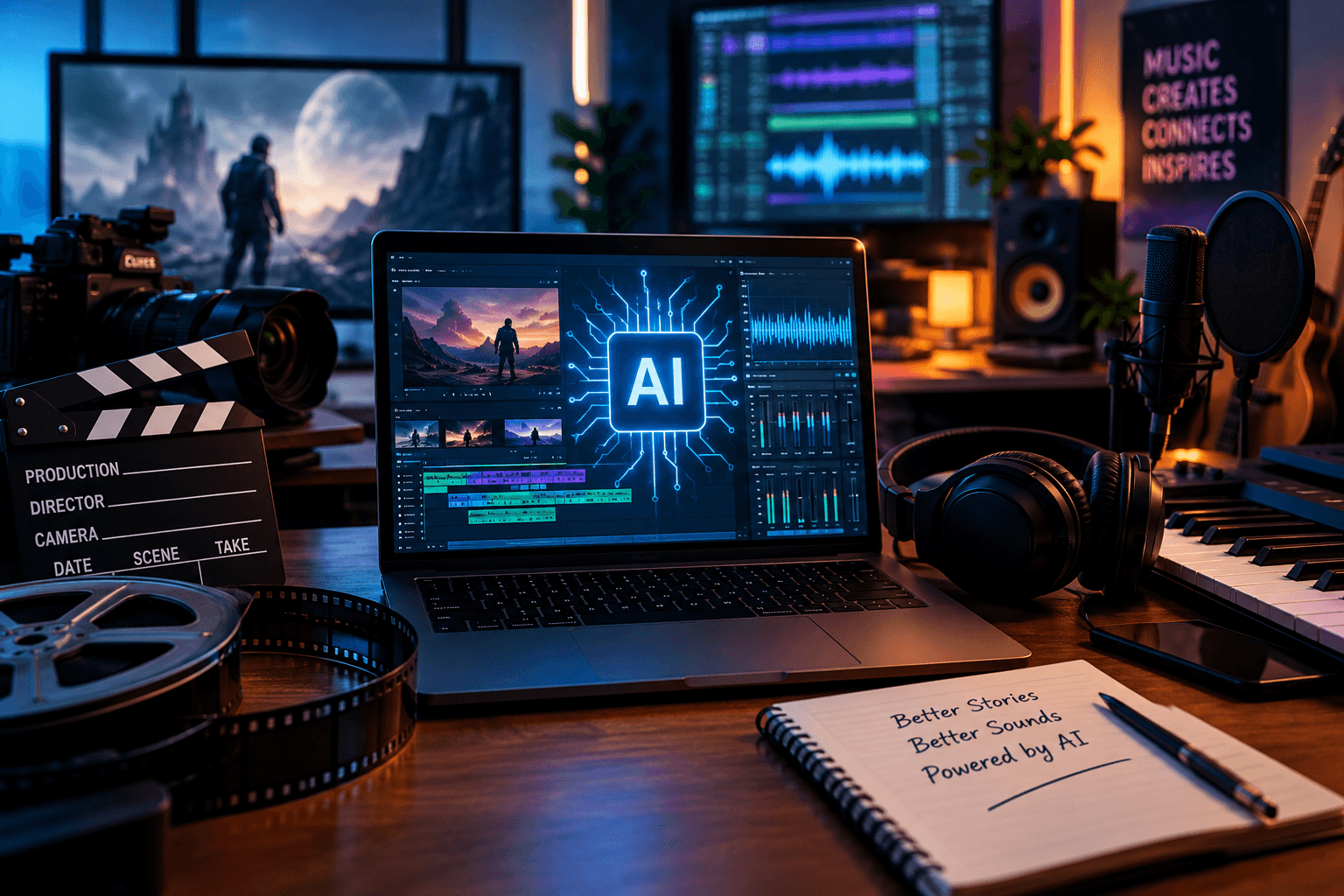
Think about the last movie you watched or the last song you listened to. Behind the scenes, technology may have played a bigger role in creating that experience than you realise. From the special effects used in movies to the tools musicians use in the studio, artificial intelligence is gradually becoming part of the entertainment industry.
Filmmakers are finding new ways to create scenes, edit footage, and bring imaginary worlds to life. Musicians are using AI to experiment with sounds, develop melodies, and improve their recordings. What once required expensive equipment and large production teams can now be done with the help of a few digital tools.
While these changes are opening new doors for artists, they are also raising concerns. Some people see AI as a chance to make entertainment more creative and accessible, while others worry about its effect on human creativity and jobs.
So, how is AI changing the film and music industries, and what could this mean for the future of entertainment?
HOW AI IS CHANGING THE WAY MOVIES ARE MADE
Making a movie takes a lot of time and effort. From planning the story to filming scenes and adding special effects, every stage requires people with different skills. AI is now helping filmmakers handle some of these tasks more easily.
AI-powered tools can help editors organise footage, remove unwanted elements from scenes, and improve video quality. They can also help create digital backgrounds and visual effects that would otherwise cost more time and money. AI can also help writers explore story ideas or different ways a scene could play out.
The clearest example so far comes from Netflix. In July 2025, co-CEO Ted Sarandos told investors that the Argentine series The Eternaut (El Eternauta) used generative AI to create a building collapse in Buenos Aires. He described it as the first generative-AI footage to appear in a finished Netflix original. Sarandos said the sequence was completed ten times faster than with traditional effects tools, and that the show’s budget could not otherwise have covered it. He framed the technology as “real people doing real work with better tools.”
HOW AI IS CHANGING MUSIC PRODUCTION
The music industry is experiencing similar changes. Today, musicians can use AI tools to experiment with melodies, create instrumental sounds, improve recordings, and explore different musical styles.
In the past, producing a song could require a professional studio, expensive equipment, and several people working together. Those resources still matter, but AI has made some parts of music creation easier to reach. An independent musician recording at home can use AI-assisted software to reduce background noise, improve sound quality, or try different arrangements. AI can also help someone who has written lyrics but is struggling to find a melody.
The technology has already shown both its promise and its risks. In November 2023, The Beatles released “Now and Then,” finished with machine-learning software that separated John Lennon’s voice from the piano on a late-1970s home demo. The voice on the record is Lennon’s own. Earlier that year, in April 2023, an anonymous creator posted “Heart on My Sleeve,” a track that used AI-cloned voices of Drake and The Weeknd. It passed 600,000 Spotify streams and 15 million TikTok views before Universal Music Group, which works with both artists, said it infringed copyright and it was pulled from streaming platforms.
AI-GENERATED ACTORS AND DIGITAL CHARACTERS
Another area attracting attention is the use of AI to create and modify digital characters.
Movie producers have used computer-generated imagery for years, particularly in action, fantasy, and science-fiction films. AI is now adding more possibilities by helping production teams create realistic facial movements, alter appearances, and work with digital versions of characters. These tools can be useful when a scene is difficult to film or a character cannot easily be created through traditional methods.
For performers, however, the concern is that their faces and voices could be reused without consent or fair pay. That worry was central to the 2023 Hollywood strikes.
The Writers Guild of America strike lasted 148 days and ended on 27 September 2023. The resulting contract says AI cannot write or rewrite literary material, and that writers cannot be required to use it. The deal left open whether studios may train AI on writers’ work, and the guild reserved the right to argue that it is prohibited.
The actors’ strike, which began in July, ended on 9 November 2023. SAG-AFTRA’s contract requires studios to obtain an actor’s consent, or their estate’s, each time a digital replica is used, with a reasonably specific description of how it will be used, and to pay for that use.
As AI becomes more capable of reproducing human appearances and voices, filmmakers will need to be careful about how they use these tools, especially when digital performances can be reused long after filming has ended.
HOW AI IS MAKING ENTERTAINMENT EASIER TO ACCESS
AI is not only changing how movies and songs are created. It is also helping people enjoy entertainment in ways that were harder in the past.
Translation is one example. AI tools can generate subtitles and dub content into other languages, helping audiences enjoy work from other parts of the world. YouTube’s AI auto-dubbing is now available to all creators in 27 languages. According to the company, an average of about 6 million viewers a day watched at least ten minutes of auto-dubbed content in December 2025. For independent filmmakers, this can make it easier to reach audiences abroad without relying entirely on expensive translation services.
AI can also support accessibility by helping generate captions and improve audio for people who have difficulty hearing certain sounds.
Of course, AI does not always get things right. Translations may miss the meaning of a joke, a cultural reference, or an important part of a conversation. Human review is still valuable, particularly when accuracy matters.
WHY STREAMING PLATFORMS KEEP RECOMMENDING MOVIES AND SONGS
Have you ever finished watching a movie and noticed that your streaming platform immediately suggested something similar? Or opened a music app and found a playlist that seemed to match your taste?
AI-powered recommendation systems make this possible. Platforms such as Netflix and YouTube use them to help users find content they may enjoy, drawing on viewing history, listening habits, and other interactions. A 2015 paper by two Netflix executives said the company’s recommender system influences about 80% of the hours streamed on the service. The figure is a decade old, but it shows how much these systems shape what audiences see.
For musicians and filmmakers, this can be helpful because their work may reach people who would not have found it otherwise. There is a downside, though. If a platform keeps recommending the same types of movies or music, users may miss out on something different, and new artists may struggle to gain attention if the systems favour content that is already popular.
The challenge is to help people discover content they enjoy without making their entertainment choices too predictable.
THE CHALLENGES OF USING AI IN ENTERTAINMENT
Despite its advantages, AI has created concerns that the film and music industries cannot ignore.
Copyright issues: One major concern is who owns music, images, and videos created with AI, and whether AI systems can be trained on creative works without their owners’ permission. In June 2024, the three major record labels, coordinated by the Recording Industry Association of America, sued AI music generators Suno and Udio, alleging their systems were trained on copyrighted recordings without permission. The industry has since split. Universal settled with Udio in October 2025, and Warner settled with both Udio and Suno. As of late September 2026, Sony and Universal were still suing Suno, and Sony was still suing Udio.
Job losses: A 2024 study of 300 entertainment executives, commissioned by the Animation Guild and other creative groups, estimated that about 203,800 US entertainment jobs could be “disrupted” by generative AI by 2026. That included roughly 118,500 in film, television and animation. The study defined a disrupted job as one where a significant share of tasks is consolidated, replaced or eliminated, not necessarily one that disappears.
Lack of originality: When creators depend too much on AI-generated material, their work may begin to feel repetitive. Technology can generate ideas, but making something distinctive still requires careful creative decisions.
Fake voices and performances: AI can imitate the voices of musicians and actors. While this can have legitimate uses, it can also be used to create fake recordings or make it appear that someone said or performed something they never did.
Privacy and consent: Artists may be concerned about their faces, voices, or previous performances being used to create new content without their knowledge or approval.
These problems do not mean AI should be rejected completely. They show why the industry needs clear rules, fair agreements, and responsible ways of using the technology.
HOW ENTERTAINMENT COMPANIES ARE USING AI
AI is already part of several services people use to watch movies, listen to music, and create digital content.
Netflix uses recommendation technology to help viewers find films and programmes, and, as noted above, has begun using generative AI in production. YouTube uses AI-powered systems to recommend videos and, as noted above, to dub them. Creative software companies such as Adobe offer AI-powered tools that can help users edit videos, improve images, and work with audio.
These examples show that AI does not always have to create an entire movie or song to make a difference. Often its main purpose is to make existing tasks easier or help people find content. For smaller creators, that can mean completing certain tasks without hiring a large team.
WILL AI REPLACE MUSICIANS AND FILMMAKERS?
This is one of the biggest questions surrounding AI in entertainment.
As AI tools become more advanced, some people worry that companies will rely on them instead of hiring human writers, musicians, actors, editors, and other creative professionals. There are reasons for concern. AI can already perform tasks that previously required human involvement, and some companies may use it to cut production costs.
The unions that fought the 2023 strikes have mostly aimed to shape AI’s use rather than ban it. SAG-AFTRA’s chief negotiator, Duncan Crabtree-Ireland, said the actors’ deal “does not block AI” but protects performers’ right to consent.
Entertainment is about more than images, sounds, and videos. People connect with a movie because of its story, or with a song because the lyrics echo an experience in their own lives. Human creativity, cultural understanding, and personal experience all shape how entertainment is made and received. Rather than replacing everyone in the industry, AI may change how many creative professionals work: some tasks will become easier, while others will require new skills. What happens next will depend on how companies choose to use AI and how well they balance efficiency with the people behind the work.
WHAT THE FUTURE HOLDS FOR AI IN FILM AND MUSIC
AI will likely become a more familiar part of entertainment in the coming years. Filmmakers may gain better editing tools and more realistic visual effects, while musicians may find new ways to experiment with sound. Independent creators could benefit from tools that make production more affordable.
The first outlines of a settlement between technology and artists are starting to appear. Warner Music’s November 2025 deal with Suno lets artists opt in to having their names, voices, and likenesses used in AI-generated music. It also commits Suno to launching licensed models in 2026. Whether other labels, artists, and courts follow that approach is still unsettled.
At the same time, the industry will have to deal with questions about copyright, job security, and the use of people’s voices and appearances. The technology may keep changing, but the need for engaging stories, original music, and meaningful performances is unlikely to disappear.
AI IS CHANGING ENTERTAINMENT, BUT CREATIVITY STILL MATTERS
Artificial intelligence is changing the way movies are made, music is produced, and audiences discover entertainment. It is helping creators complete tasks more easily, experiment with new ideas, and reach people in different parts of the world. Its growing influence also raises concerns about copyright, employment, privacy, and originality.
AI can be a useful tool, but it is not a guarantee of good entertainment. A film still needs a story worth watching, and a song still needs something that makes people want to listen. The future of the industry may depend on finding a way for technology and human creativity to work together.
Read our editorial standards and corrections policy.