
North Korea Commissions Second Destroyer as Kim Pushes Toward a Nuclear-Capable Navy
Kim Jong Un says the new 5,000-ton warship will become part of North Korea's nuclear response system as Pyongyang accelerates its naval expansion, timed to a moment of rising pressure with Washington.
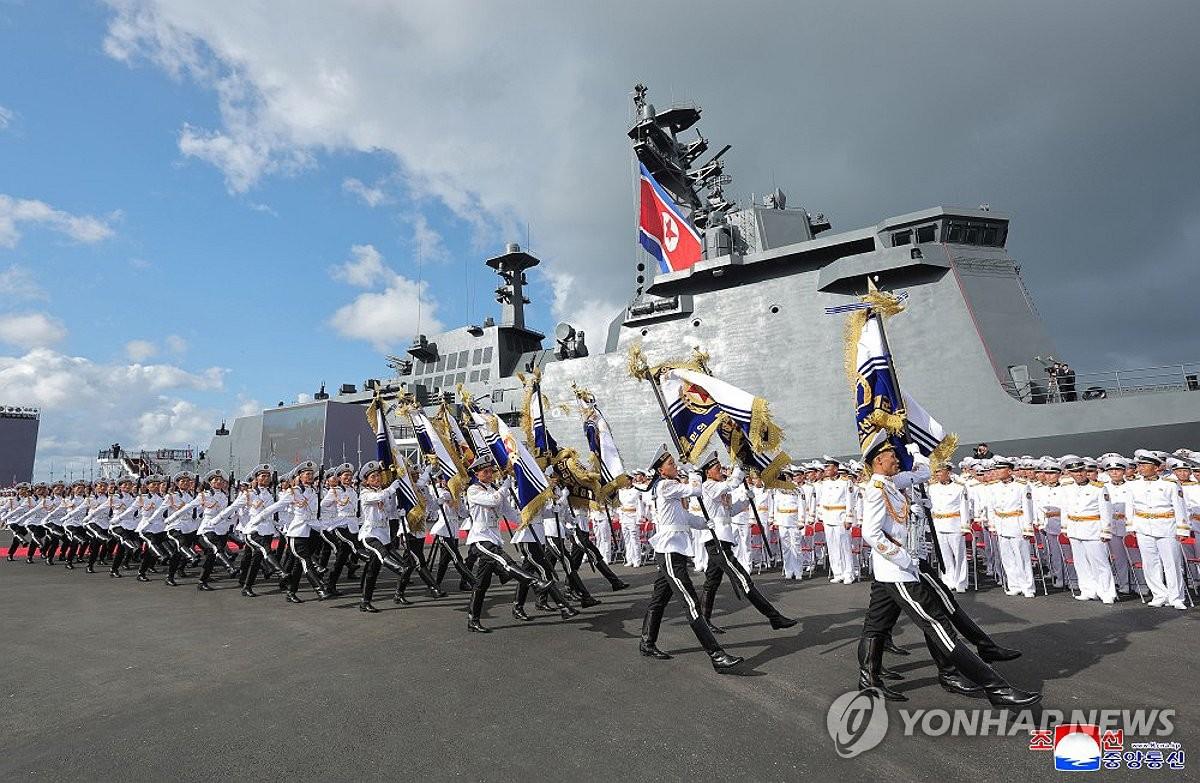
North Korea has commissioned a second modern destroyer as leader Kim Jong Un pushes to turn the country's navy into a more important part of its nuclear military strategy.
The 5,000-ton-class Kang Kon was formally commissioned at the eastern port city of Wonsan on Sunday, September 6, according to North Korean state media. Kim attended the ceremony and said the vessel would be capable of delivering what he described as devastating retaliatory strikes against an enemy.
The announcement is important because North Korea has traditionally relied heavily on land-based missiles and nuclear weapons. Kim is now signalling that his government wants some of that capability to move to sea.
The timing is not a coincidence
The commissioning came as the United States, South Korea and Japan began a trilateral military exercise that Kim views as a security threat.
It also follows North Korea rebuffing a conciliatory gesture from President Donald Trump, who had scaled back a major joint military drill with South Korea in an apparent bid to ease tensions with Pyongyang. Observers say North Korea is using the moment to press for bigger concessions from Washington rather than accept the gesture as sufficient.
Analysts also note that Kim now has more room to maneuver than in past standoffs, pointing to North Korea's deepening military and diplomatic ties with Russia and China as a source of added leverage.
What has North Korea actually commissioned?
The Kang Kon is the second destroyer of the same class as the Choe Hyon, which was commissioned in June, about three months earlier.
North Korean state media said the new vessel has the same weapons systems as the Choe Hyon. Both ships are equipped with nuclear-capable missiles, making them North Korea's most advanced warships to date. Kim said the back-to-back commissioning of the two destroyers was intended to instill fear in North Korea's adversaries, framing it as a way to exercise the country's nuclear deterrent "in a more diversified, practical manner."
North Korea has not disclosed precisely which weapons are currently loaded aboard the Kang Kon, and independent observers have not confirmed an operational nuclear warhead is deployed on the vessel. But Kim's own remarks tie both destroyers directly to the country's declared nuclear strategy.
why does a nuclear-capable warship matter?
A nuclear force becomes harder to eliminate if it can operate from different locations.
Land-based missiles are tied to launch sites that an opponent can attempt to locate and target. A warship, by contrast, can move.
That does not automatically make the Kang Kon a nuclear submarine or prove that it can secretly carry out a nuclear strike. But if North Korea eventually succeeds in deploying nuclear-capable missiles from a larger and more sophisticated fleet, it could give Pyongyang another way of threatening an opponent after an attack.
That appears to be the strategic direction Kim is describing. He said the Kang Kon would be integrated into North Korea's "state nuclear counteraction system," framing the ship as part of the country's effort to strengthen maritime sovereignty and deterrence.
Kim wants more than two destroyers
The Kang Kon is not being presented as a one-off project.
Kim said North Korea would continue expanding its naval forces, including the construction of new naval bases along the country's east coast and the development of different classes of warships. State media has also reported that construction of a third destroyer of the same class is already underway at a separate shipyard.
That suggests Pyongyang sees naval power as a long-term part of its military strategy rather than simply an attempt to add a few new ships to its existing fleet.
Why is North Korea building a nuclear-capable navy?
North Korea says the buildup is necessary because of what it describes as threats from the United States and South Korea.
Kim specifically pointed to waters around the Korean Peninsula and argued that North Korea faces continuing security threats there. His government presents its growing nuclear and conventional military capabilities as a form of deterrence.
The United States, South Korea and Japan, meanwhile, view North Korea's weapons development as a major security concern. Their trilateral exercise, under way as the Kang Kon entered service, is itself a point of friction that Pyongyang has repeatedly objected to.
The Kang Kon had a difficult journey into service
The destroyer's development has also been unusually complicated.
The vessel partially capsized during its initial launch attempt in May 2025, an incident Kim called a "criminal act." It was subsequently repaired and relaunched before undergoing further repairs and sea trials.
According to reporting, the ship completed weapons testing, including a demonstration of its nuclear-capable cruise missile, in July 2026 before being formally commissioned at Wonsan.
Its commissioning therefore represents more than the unveiling of a new warship. It marks the completion of a lengthy and, at times, embarrassing effort by North Korea to put a modern surface combatant into operational service.
What does this mean for the region?
For South Korea, Japan and the United States, the concern is not simply the size of the Kang Kon.
The bigger issue is what North Korea is trying to build around it.
Pyongyang is talking about new warship classes, additional naval units and new naval bases, while linking the development of its navy directly to its nuclear strategy.
If that programme continues, North Korea could gradually develop a more diverse nuclear force, with weapons based not only on land but potentially on naval platforms.
For now, however, there is an important gap between North Korea's stated ambitions and what is independently confirmed about its actual naval nuclear capability.
What happens next?
North Korea says it plans to continue building warships and naval infrastructure, with a third destroyer of the class already under construction.
The immediate question, therefore, is not whether North Korea has suddenly become a major naval power. It has not.
The more important questions are how quickly Pyongyang can turn its stated ambition of a nuclear-capable navy into a reliable operational capability, and whether this show of force pushes Washington toward the kind of concessions North Korea is seeking.
In Summary: North Korea has commissioned its second Choe Hyon-class destroyer, the 5,000-ton Kang Kon, timed to a US-South Korea-Japan military exercise and North Korea's rejection of a US conciliatory gesture. Kim Jong Un says the ship will form part of the country's nuclear response system, and a third destroyer of the same class is already under construction.
Read our editorial standards and corrections policy.