
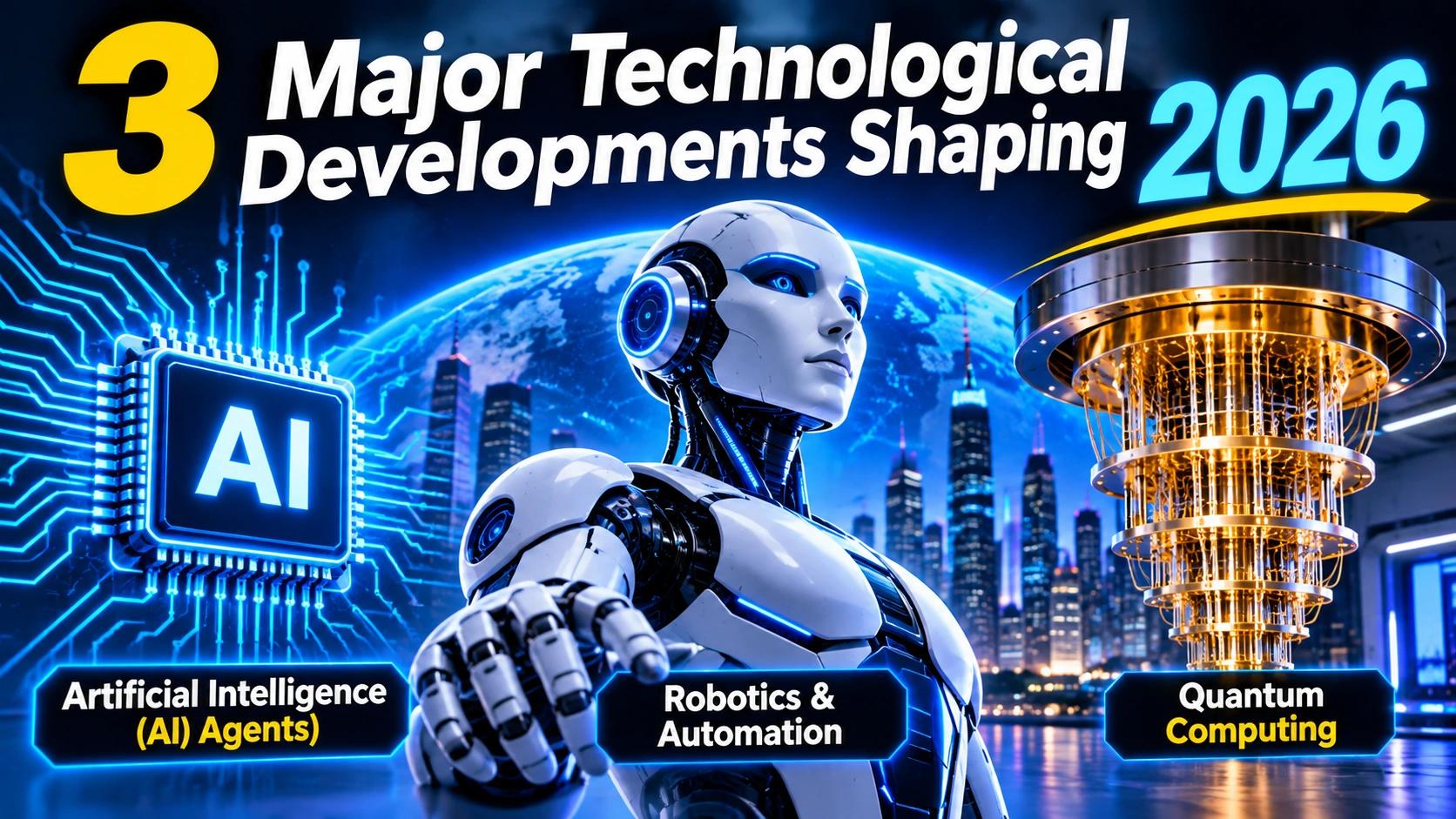
3 Major Technological Developments Shaping 2026
Artificial intelligence agents, intelligent robots and quantum computers are pushing technology into new territory. Although they are developing at different speeds, each could change how people work and how industries solve complex problems.
Technology continues to advance, changing how people work, communicate and solve everyday problems. From artificial intelligence taking on more complex tasks to robots becoming more intelligent, innovation is gradually moving beyond what many people once imagined.
Some of these technologies are already being used by businesses and researchers, while others are still under development. However, they all point towards a future where machines can perform more tasks, computers can tackle increasingly complex problems and technology will play a bigger role in everyday life.
Among the developments attracting attention in 2026 are artificial intelligence agents, advanced robotics and quantum computing. Each is progressing at a different pace, but all three could have a lasting impact on industries and society.
ARTIFICIAL INTELLIGENCE IS MOVING BEYOND CHATBOTS
Artificial intelligence has become one of the biggest technology stories in recent years. Tools that once struggled with simple questions can now generate images, write content, analyse information and assist with software development.
But the next stage of AI is about more than answering questions. Attention is increasingly shifting towards AI agents.
Unlike ordinary chatbots that mainly respond to instructions, AI agents are designed to carry out tasks through multiple steps. Depending on the system, they can plan activities, search for information, use software and make decisions along the way, with varying levels of human supervision.
For businesses, this could mean using AI to handle routine administrative work, organise information, assist customers and support employees with daily tasks. In software development, some systems can already help write code, test applications and identify errors.
This does not mean human workers are no longer needed. AI agents can still make mistakes, misunderstand instructions or produce unreliable results. Important decisions also require human oversight.
Nevertheless, their growing capabilities could change how organisations operate. Instead of using AI only for individual tasks, businesses are beginning to explore systems that can manage entire workflows.
ROBOTICS IS BECOMING MORE INTELLIGENT
Robots have been used in factories and manufacturing for decades, particularly for repetitive tasks that require speed and precision. What is changing now is the level of intelligence being added to these machines.
Advances in artificial intelligence, cameras and sensors are helping robots understand their surroundings and respond to changes rather than simply follow fixed instructions.
This development is often described as physical AI. It brings artificial intelligence into machines that can interact with the real world.
In warehouses, robots can help move goods and organise products. In agriculture, they are being developed to assist with planting, monitoring crops and harvesting. Healthcare is another area where robotic systems can support medical professionals with certain procedures and hospital tasks.
There is also growing interest in humanoid robots, which are designed to perform tasks in spaces built for people. Although many are still being tested, improvements in movement and decision-making could make them more useful in workplaces.
However, there are still challenges. Robots can be expensive to develop and maintain, and they must operate safely around people. They may also struggle with unfamiliar environments and tasks that require flexibility.
Even with these limitations, the combination of AI and robotics could change how physical work is carried out across several industries.
QUANTUM COMPUTING COULD CHANGE THE FUTURE OF COMPUTING
While AI and robotics are becoming more visible, another important development is taking place in the world of computing.
Quantum computing uses principles of quantum physics to process information differently from traditional computers.
Ordinary computers use bits, which represent information as either 0 or 1. Quantum computers use quantum bits, known as qubits, which can exist in combinations of states through a property called superposition.
This gives quantum computers the potential to tackle certain complex problems that would be extremely difficult for conventional machines.
Researchers are exploring possible applications in areas such as medicine, materials science, chemistry and financial modelling. For example, quantum systems could eventually help scientists simulate complex molecules and investigate materials with properties that are difficult to study using traditional computing methods.
However, quantum computing is still at an early stage. Current machines face challenges involving errors, stability and the difficulty of maintaining qubits. They are not designed to replace ordinary computers or smartphones.
Instead, their value may come from solving specialised problems that traditional computing systems struggle with.
Although widespread commercial use is still some way off, continued research could make quantum computing an important part of future technological development.
THE CHALLENGES THAT COME WITH THESE DEVELOPMENTS
Despite the opportunities these technologies offer, their growth also comes with concerns.
AI systems raise questions about privacy, inaccurate information, job changes and responsible use. Businesses must also ensure that important decisions are not left entirely to automated systems.
Robotics presents its own challenges, particularly around cost, safety and how automation could affect certain jobs. Workers may need new skills as companies introduce more automated equipment.
Quantum computing also faces technical and financial barriers. Developing reliable quantum machines requires specialised equipment, skilled researchers and significant investment.
These challenges show that technological progress is not simply about creating more advanced machines. It also involves making sure they are reliable, affordable and useful to society.
WHAT THESE DEVELOPMENTS MEAN FOR THE FUTURE
Artificial intelligence, robotics and quantum computing are developing in different ways, but their progress shows how technology is expanding into areas that once seemed beyond the reach of ordinary machines.
AI agents could change how digital tasks are completed, intelligent robots could transform physical work, and quantum computers may eventually help solve problems that conventional systems cannot handle efficiently.
Their impact will not happen overnight, and some of their biggest promises are still being tested. However, the progress made so far suggests that these technologies will remain important areas of innovation in the years ahead.
As 2026 continues, the focus is no longer just on what technology can do. It is also about how people and businesses can use it responsibly to solve real problems.
Read our editorial standards and corrections policy.