
The New Space Race: How Satellites Are Changing Internet Access
Satellite technology is reshaping how people access broadband, connect their devices and stay online, including in places where traditional networks are difficult to build.
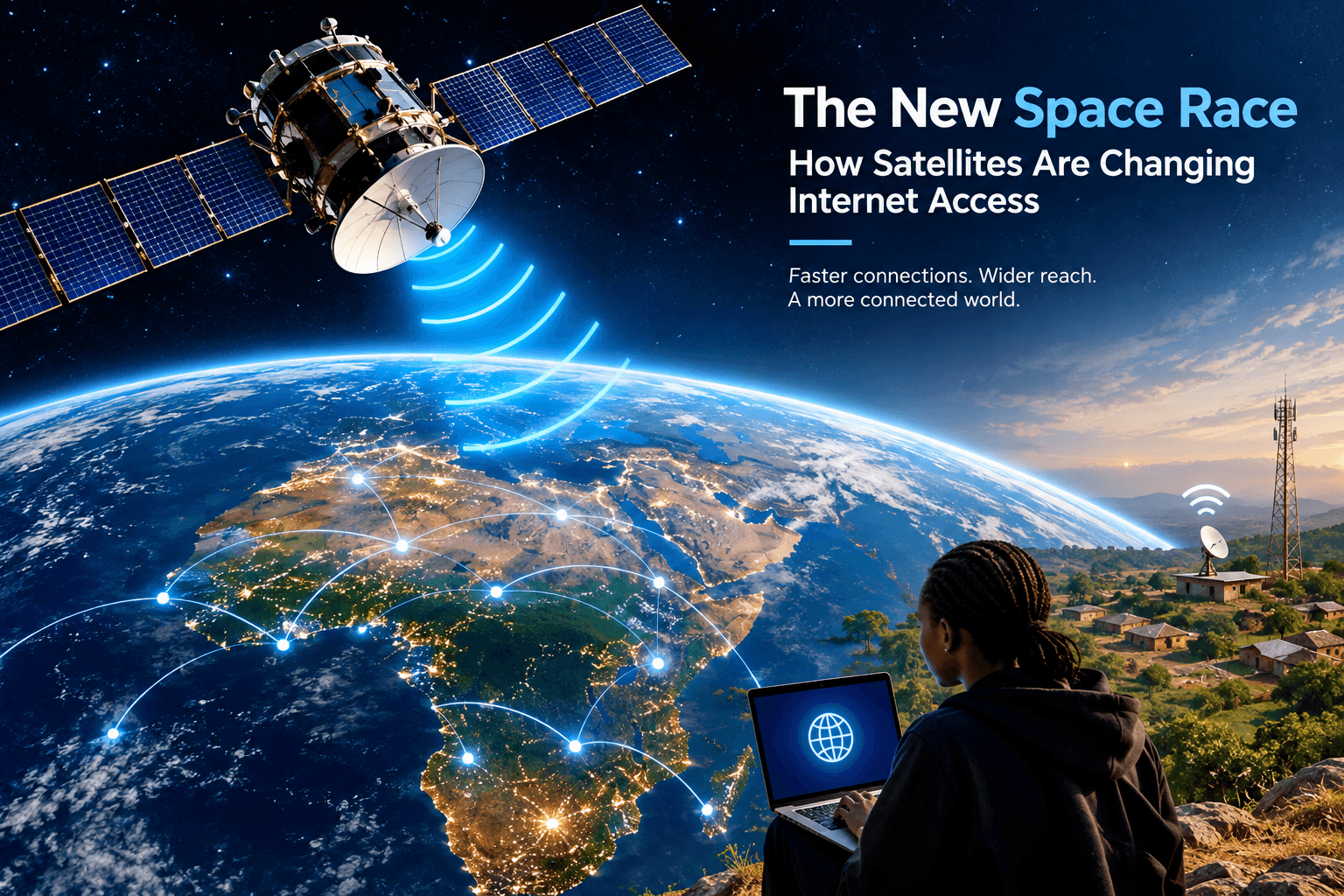
Internet access has become essential to everyday life, but millions of people still struggle to get reliable and affordable connections.
Traditional networks rely on fibre-optic cables, mobile towers and other ground-based infrastructure. Now, companies are taking another approach by building large satellite networks designed to provide internet connectivity from space.
This has created a new space race, with companies competing to build faster, wider and more reliable satellite networks.
How Does Satellite Internet Work?
Satellite internet uses satellites orbiting Earth to transmit data between users and the wider internet.
Many newer systems use Low Earth Orbit (LEO) satellites. These operate much closer to Earth than traditional communication satellites, reducing the delay between sending and receiving data.
In simple terms, LEO satellites can provide lower-latency connections than older satellite systems, making them more suitable for applications that require faster communication.
Satellites Are Joining Terrestrial Networks
Satellite internet is increasingly being combined with existing fibre and cellular networks rather than replacing them completely.
These hybrid networks can improve coverage and provide backup connectivity when traditional networks experience outages. They can also help connect rural and remote areas where building ground-based infrastructure is difficult.
Another development is the growth of multi-orbit networks, which combine GEO, MEO and LEO satellites. Each orbit offers different advantages in terms of coverage, capacity and latency, allowing providers to use different systems for different needs.
Direct-to-Device Connectivity
One of the most interesting developments is Direct-to-Device (D2D) connectivity.
D2D allows compatible smartphones and IoT devices to connect directly to satellites without requiring a specialised satellite terminal for basic services such as messaging and data.
The technology is still developing, but it could become particularly useful for emergency communications and extending mobile coverage to areas without reliable terrestrial networks.
The Companies Behind the Race
Several companies are competing to expand satellite internet.
SpaceX, through Starlink, has become one of the most prominent players, using a large constellation of LEO satellites to provide internet services across many parts of the world.
Amazon is also developing Project Kuiper, its satellite broadband network.
Other satellite operators are pursuing similar technologies, increasing competition and investment in the sector.
The Challenges
The growth of satellite internet also creates challenges.
Building and maintaining large satellite constellations requires significant investment. More satellites in orbit also raise concerns about space debris and the long-term sustainability of Earth's orbital environment.
There are also spectrum and regulatory challenges as more satellite networks compete for available frequencies.
Another concern is their effect on astronomy. Large numbers of satellites can interfere with observations of the night sky, creating challenges for researchers studying space from Earth.
What Could the Future Internet Look Like?
The future of internet connectivity may not belong to satellites or terrestrial networks alone.
Instead, fibre, mobile networks and different satellite orbits could work together, with each providing connectivity where it is most suitable.
As satellite technology develops, the goal is becoming less about replacing traditional networks and more about creating a global, flexible and resilient connectivity system.
The new space race is therefore not just about putting satellites into orbit. It is about using space to change how people on Earth connect to the internet.